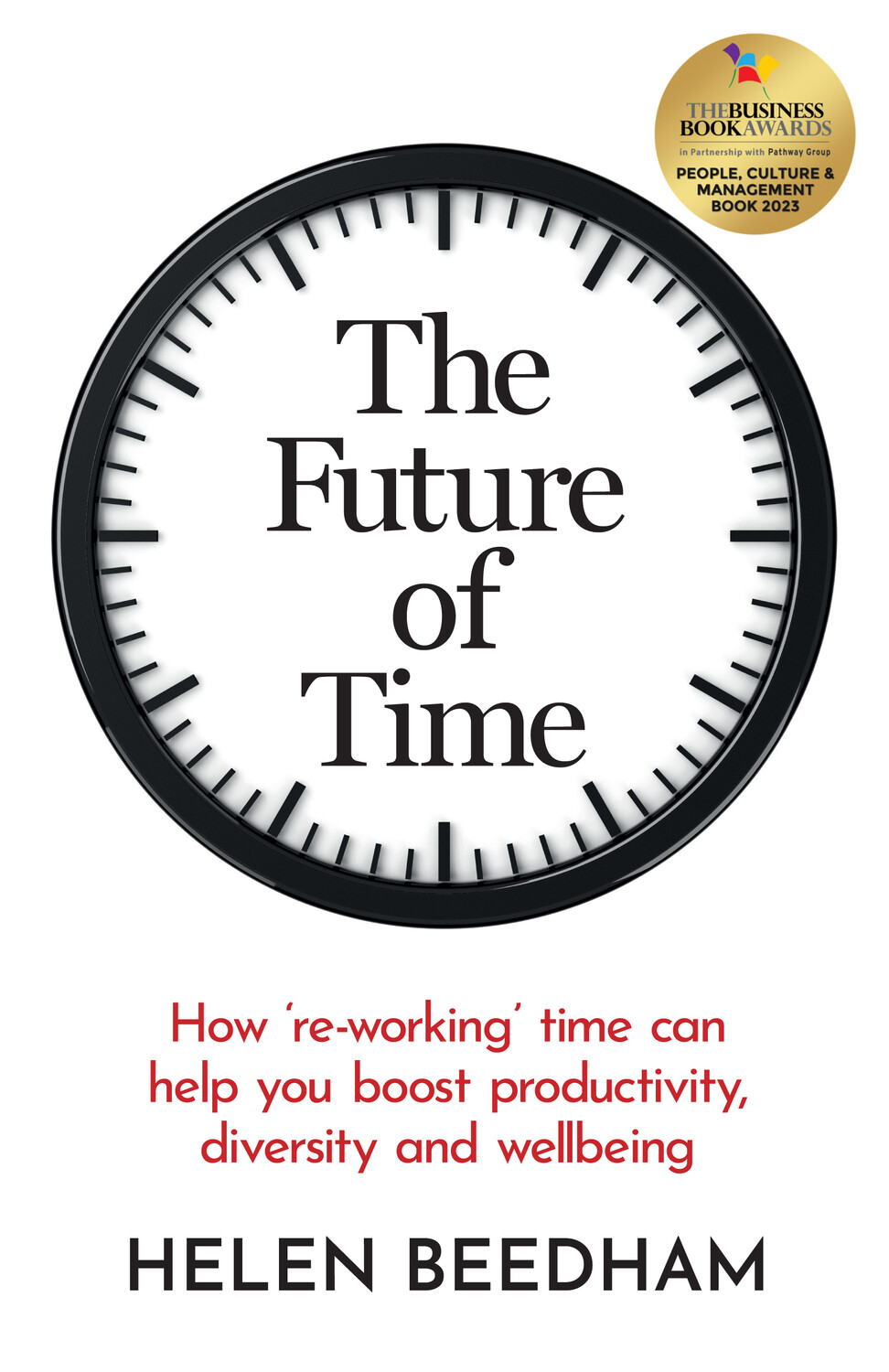
The Future of Time
How ‘re-working’ time can help you boost productivity, diversity and wellbeing
Helen Beedham
Description
**Business Book Awards 2023: People, Culture & Management Book of the Year**
The way we value and manage time at work is broken.
Businesses are squandering time when making decisions, delivering work and managing people. Employees are rewarded for 24/7 availability, speed of response and hours worked.
The results are clear: low productivity; high stress and burnout; falling retention; and stalling diversity.
The Future of Time reveals how ‘re-working’ time – transforming organizations by adopting positive time practices – can help you build a more diverse, engaged and productive workforce.
- Diagnostics to quickly assess the ‘time defects’ damaging your business
- Compelling evidence, case studies and strategies to ‘re-work’ time successfully
- Timelines and tools to bring about fast, effective change.
Helen Beedham, MA Cantab, speaks, consults and leads research on how to create more inclusive, productive workplaces where everyone can flourish. For the past 25 years, as management consultant then chair of a City-wide professional network, she has led change programmes for FTSE 100 businesses and regularly brought together Heads of HR, Diversity, Inclusion and Wellbeing to exchange market-leading practices.
Reviews
I would see this as a self help book to examine and tackle our actions with time, particularly our schedules and how we can better hack them for efficiency. I believe this book would do well as a companion piece with any book that addresses habit formation.
NetGalley
A fascinating and comprehensive guide to ensuring better outcomes for businesses and their employees. Helen analyses and dissects the issues in a succinct and articulate way making this a must-read for employers and employees alike.
Amazon
A must read for CEOs, leadership teams, People teams and anyone interested in organisational culture, productivity and inclusion.
Insightful, thought provoking and well-written and I’ve not even got to the section with all the practical tools you can use within your organisation. There is a ridiculous amount of value in this book.
Amazon
With the rapid growth of working from home over the last two years, both employers and employees are coming to realise that work/life balance and productivity are intricately linked, and “The Future of Time” offers useful ways of looking at time within your business to see how it could be used better, allowing employees to be both more productive and happier at the same time, and allowing employers to reap the benefit of a more engaged, and more content, workforce.
I feel that there is something within its pages for everyone, at all levels of organisations big and small.
Amazon
‘..provides helpful guides to rework our management of our own time as well as for the people who work under us. This is a good read for people in management to set the culture of good time usage.’
NetGalley
The author tackles a complex subject in an engaging and pragmatic way and shares various positive examples from a range of companies and industries. I’ve seen the book featured in a number of business and HR publications and podcasts since it launched, so it’s clearly tapping into a hot topic in today’s world of work
Amazon
Helen Beedham’s wonderful book offers a fresh and much-needed look at a long-standing problem that we’ve historically failed to address. Situating time management as a clear business issue, Beedham offers a cornucopia of practical tools that you can use today, whatever your role and industry. She advocates persuasively for a better way of working that will enable happier, healthier work lives. Beedham combines rigour and curiosity, creating a book that is well-researched, clearly structured and accessible. This is an excellent read.
Amazon
‘This is not just a book on time management. It explores ways of working, productivity, diversity and wellbeing. It is practical and inspirational….[it] looks at time management holistically, along with a range of tools and techniques.’
Edge Journal (The Institute of Leadership and Management.)
Endorsements
There are so many ways in which we talk about time, we think about time, and we worry about time. But how many of us as leaders really put the necessary time into managing time? The Future of Time is a must-read for anyone who, like me, works in a knowledge and ideas business where time and people are your two most valuable assets. It will save many hours, in many days, for you and many others. – Lord Carter, Stephen A. Carter CBE, Group Chief Executive, Informa plc
Every leader who is interested in building an inclusive culture, maximizing the benefits of highly engaged and empowered people and nurturing innovation, productivity and profitability should read this book. Time is the invisible frontier that must be embraced and put at the heart of all organizations that wish to thrive and build sustainably towards a better future for all. Helen captures the potential time offers for intelligent growth and how to bring it to life in your organization. – Caroline Waters OBE
The Future of Time is a practical and well-written antidote to the dehumanization of the modern workplace. Helen inspires us not to serve time or to pass it, but to be courageous in changing how we see it. By doing this, we can create the opportunity for deeper meaning in our work, for richer connections with our co-workers and for greater value to our organizations. Simon McBride, Head of People & Organization, Investec plc
The COVID-19 pandemic has triggered a re-evaluation of the workplace and the way we work. The Future of Time is highly relevant: it challenges us to reassess our attitude towards time at work from many different perspectives, and to create a time-aware culture fit for purpose in today’s world. Solutions which enable the effective use of time and time intelligent leadership are examined. The result is a thought-provoking and invaluable guide to the role of time in the future of work which will benefit employers and employees alike. – Dame Janet Gaymer DBE, QC (Hon.)
Helen has a way of writing that is captivating and thought-provoking. The Future of Time makes us think of time in a new, more ’21st century’ way. As increasingly more people work from home, the frameworks that Helen offers will make a real, practical difference in the workplace. – Dr Julie Humphreys, Group Head of Diversity and Inclusion, Reach plc
Our time is precious. As someone who tries to fit too much of everything in, this book made me think as a worker, a chief exec, a husband and a human. Helen presents a compelling picture of why we need to think about time differently and offers practical, clear strategies for change. – Simon Blake OBE
I loved this book. It reflects Helen’s style: calm, inclusive, reflective and with a laser-sharp focus on solutions to the problem. The format made my heart sing: a clear description of the issue, well referenced, with excellent summaries at the end of each chapter. The Future of Time could make such a difference to the world of work for so many people. It tackles head on the BIG question that businesses should be answering for themselves: what is the impact to society as a whole, to increasing levels of inequality, and to business profitability and productivity, when knowledge workers are ‘subsidising’ their paid hours with unpaid hours? The way we view time is broken. Helen has the solution. – Jane van Zyl, Chief Executive, Working Families
If you are looking to create systematic change within your organization, look no further than The Future of Time. In this insightful and action-packed book, Helen Beedham gives leaders the tools to identify common time deficits, overcome collective time blindness, and put into place tactical steps to rework time, improve engagement and bolster productivity. With employees more exhausted than ever, and organizations losing their best talent to time poverty, this book comes at a perfect moment. Now is the time for leaders to act, and Helen provides everything leaders need to take the first steps toward collective time affluence. – Ashley Whillans, Assistant Professor of Business Administration, Harvard Business School; author, Time Smart
Contents
Table of Contents
Foreword
Introduction
- A story about time
- The path to here and now
- ‘The Future of Time’s central premise
- How ‘The Future of Time’ will help you and your organization
Part 1: The ticking timebomb
How we’re collectively failing to manage time.
- Chapter 1: Time today
How we value and treat time in business today - What knowledge-based businesses value now
- How businesses typically value time
- How we typically think about time at work
- What we mean by collective time management
- How we factor time into our decision-making
- What our typical collective ‘time habits’ are
- Chapter 2: Time blindness
Why we have developed time ‘blindspots’ in the workplace - What ‘time blindness’ is and why we aren’t talking about this
- How time is ‘baked into’ our structures and processes
- We mainly talk about time in terms of the working week & working patterns
- Accepted, non-verbalised norms relating to time
- How technology is helping/hindering
- How time blindness manifests itself
- Chapter 3: Time defects
How to recognise the signs of ‘broken’ time in your organization - Some verbal and visual indicators
- How time defects affect employees generally
- How they affect individuals
- How we are valuing and measuring time wrongly
- How we are being wasteful with time
- Time defects: steady drip or major time fails?
- What we are rewarding in the way we value and measure time
- Chapter 4: Changing times
What’s influencing our wider relationship with time
o Big pressures impacting businesses that relate to time
o Major demographic factors affecting our approach to time
o How climate change is affecting our relationship with time
o Other factors influencing the way we run businesses today
o Social justice movements that are relevant here
o So what? What employers need to be paying attention to
- Chapter 5: Out of time
How ‘broken’ time is hurting your business and why you need to act now
o The impact of ‘broken time’ on businesses
o How it is hurting productivity
o How it is impacting diversity and inclusion efforts
o The impact on employee engagement, motivation and retention
o The link to employee wellbeing
o Why this is urgent
- Key points summarised
Part 2: Time re-worked
Better ways of valuing & managing time.
- Chapter 6: Time reimagined
What the future of time looks like at work
o What the future could look like in broad terms
o How leaders could run businesses differently
o How commercials/financials could be managed
o How people could be managed
o What future working practices could look like
o What a more time-aware organization culture looks like
o Outcomes we would see
- Chapter 7: Time solutions
The positive time practices that enable organizations to flourish - Ways we can be more ‘time aware’
- Implications for leaders in their day-to-day choices and action
- How teams can implement more time-aware practices
- Time solutions for different kinds of work
- Interpersonal relationships
- Time-aware commercial practices
- Time solutions that enable better employee wellbeing and more sustainable careers
- Chapter 8: Time and talent
Implications for recruiting, managing and developing people - How we bring people into the organization
- The jobs they do
- Reflecting time-awareness in individual and team goals
- HR, D&I and other workplace policies
- How to build better time-awareness into people management
- Pay and benefits
- Time-aware careers
- Chapter 9: Ahead of time
Organizations that are leading the way in managing time - Proof it’s possible to achieve this
- What other organizations are successfully focusing on
- 4 case studies
- Impact of their efforts so far
- What they are learning that will help the reader
- Key points summarised
Part 3: Time to act
How to re-work time in your organization
- Chapter 10: Taking stock of time
How to diagnose your time defects and get time on the agenda - How to find out what your time defects are
- How to gather evidence and create a burning platform
- How to tell if it’s an emergency/how bad it is
- How to get senior buy-in and support for addressing this
- Chapter 11: Time strategies
How to tailor and implement your time solutions successfully - How to tackle it and how long it will take? Some principles
- What you’ll need and how much it’ll cost
- Where to start, how to prioritise, what order to adopt
- What will help make/accelerate progress
- 3 implementation tools to help avoid reinventing the wheel
- Pitfalls and setbacks to watch out for
- How to assess progress
- Chapter 12: Anchoring time
How to embed new time practices in your work culture - Why embedding matters
- What embedding means – some examples
- Who needs to do what to embed time practices
- Specific embedding actions for productivity
- Specific embedding actions for diversity
- Specific embedding actions for wellbeing
- After that, are we done? (no)
- Chapter 13: Time toolkit (this may move into the Appendix)
Further resources to help you deal with challenges and stay on track - Agendas and/or checklist for business leaders, HR, D& I leaders, team managers, individuals ‘What can I do as …?’
- Ongoing time check-ins
- Ways to share and celebrate your time successes
- Time solutions mini-library (e.g. ‘100 time solutions’)
- Key points summarised
Conclusion
- A closing story about time
- Hopes for the future
- ‘Book on a page’ (1 page book summary)
Acknowledgements
Notes
Index
About the author
Join the ‘Future of Time’ community
Editions
FORMAT / ISBN / PUBLICATION DATE / RRP
Paperback / 9781788602631 / March 1, 2022 / £14.99
Ebook / 9781788602624 / February 28, 2022 / £7.99
Paperback and eBook Bundle / £16.99
Authors
Helen Beedham
Helen Beedham is an organizational expert, speaker, and host of The Business of Being Brilliant podcast. Her first book The Future of Time: How ‘re-working’ time can help you boost productivity, diversity and wellbeing was named People, Culture & Management Book of the Year at the Business Book Awards, and she regularly comments on the future of work in national, business and HR press.